Skip to: How Do Telescopes Work?
How Do Telescopes Work?
Telescope basics, reviews, accessories, and more!
The First Telescope Made by Galileo
We all know that Telescope
was invented by Galileo and he is also sometimes called as the father
of telescopes. All of the telescopes today are using the same principle
introduced by Galileo.
The telescope made by Galileo was very simple in comparison with the one that are in use today but Galileo’s telescope provided the basic principles that are still in use.
Galileo telescope was a tube light device with two lenses; the convex and the concave lens. Convex lens are curved towards outside and concave lenses are curved towards inside.
The concave lens was used as an eye-piece. Galileo was inspired by one of the invention of his time; spy glasses that were used to examine closely different enemy camps by the militants.
The main principle of Galileo’s telescope, and almost all of telescopes available today, was the combination of two lenses in order to gather more light. Human eye also acts as a lens but it can’t gather that much light.
The two lenses are used in telescopes that enable it to gather more light.
According to the principle, the two lenses would gather the light and
would focus the gathered light to build an image.
This image is formed due to refraction which is the reason that sometimes these telescopes are also called as the refractors or refracting telescopes. The term refracting, in the context of telescope, means the bending of the gathered light in order to form its image.
Galileo’s telescope was able to magnify an object about 30 times. The image made by the Galileo’s telescope was, however, distorted and blurred because of the shape of the lens.
Even then the Galileo’s telescope was one of the most exciting tools to view the night sky. He was able to explore the moon with his telescope. Galileo kept on experimenting with his telescope by using different combination of telescope lenses.
He also realized that the magnification, provided by a telescope, is directly proportional to “Power of Concave lens / Power of Convex lens”. This gave his the idea that if he needs better magnification, he should have a combination of a strong concave lens and a weak convex lens.
One problem at that time was that the opticians were only making lenses with lower strengths. So, with no other option, Galileo started grinding his own lenses for his telescope.
Soon, Galileo achieved about 9 x magnifications. He himself made lenses to be used in his own telescope. It was another remarkable achievement for him.
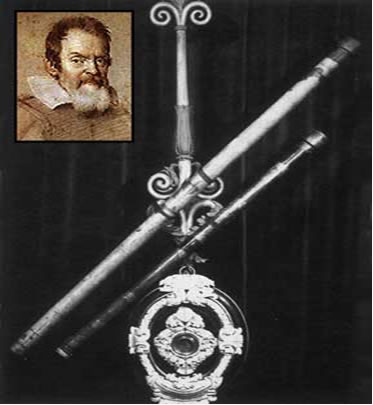 With the passage of time, Galileo made excellent improvements
in this telescope. He also went to the Senate of the Venice in order
to demonstrate the device that he has made.
With the passage of time, Galileo made excellent improvements
in this telescope. He also went to the Senate of the Venice in order
to demonstrate the device that he has made.
There were many senators at that time who reached the highest bell towers of that time to look through Galileo’s Telescope at various ships far from their location. The senators were greatly impressed and they found real potential benefits for military purposes.
The invention of the Galileo’s telescope is one of the integral parts of the history of astronomy. After its invention, many people tried to make copies of it following the same principle that were invented by Galileo.
With the passage of time and
the improvements in technologies,
astronomers made much bigger and powerful telescopes as compared to Galileo’s
telescope by using the same principles. Without Galileo’s telescope,
we wouldn’t have the amount of information about our earth and its
surrounding that we have today.